I am loving what the BFI has been doing, re-telling the story of twentieth century Britain through collections of occasionally familiar but mostly undiscovered documentaries.
The newest collection in the series, Shadows of Progress, has just been released, and I've spent a happy couple of days trawling through it.
The films here are much less well-known than those from the earlier period: television gradually took over from the cinema as the place where we expected to see factual programming, and the film documentaries made during this period have been neglected.
Geniuses like John Krish -- who was an assistant to the great Humphrey Jennings before the Second World War -- made extraordinary films including the wonderful The Elephant Will Never Forget, an elegy to the last week in service of the London tram.
Three of Krish's other films are also presented here, including a delightful documentary following a group of children from the Birmingham slums taken on a day trip to the seaside.
There is also colour, of a sort, with films looking at the booming New Towns (that was Harlow), and later works sponsored by oil companies and others.
So many of these stories are very moving (that was a small boy recovering from polio), although most of them feel clunky in parts, a reflection of changing social fashions and speech, and of our own experience of reality filmmaking.
Krish spoke at the National Film Theatre the other week, and summarised his philosophy of being "a part of" rather than "apart from": that humanity informs most of the documentaries in this set.
It is an extraordinary partner to the previous set, Land of Promise.
That covered the emergence of the documentarists, through the propaganda period of the Second World War and into the daylight of the immediate post-War era.
Rather morbidly, I struggle to watch those films without the knowledge that almost everyone depicted in them (other than the children) is now long-dead.
And yet, these films make them live. There is something touching and moving about getting closer to these people.
Both box sets are highly recommended -- a great way to while away the interminable Christmas holidays without having to speak to your relatives.
Trains, films, architecture, my photography, and interminable pictures of small winkies. A veritable snack.
Sunday, 14 November 2010
Contrition
It's possible I may have been a tad dismissive of the joys of St Alban's cathedral the other day, by summarising it as mostly "lumpen Victorian".
So I thought I ought to make it up to you.
Outside, the cathedral does indeed suffer from all sorts of Victorian interventions, but it also has a rather jolly 1980s lean-to (for the Chapter House, Library and the inevitable cafe), in the form of a rather fine Roman-style brick basilica.
While the bricks have been laid in traditional English "garden wall" bond, the bricks themselves are not traditional: in fact, so flat they are almost tiles, they are much closer to Roman bricks than traditional English.
There are some rather good earlier remains, too: St Alban's cathedral was, originally, an abbey (and, in fact, the premier abbey in England), although little remains of the Medieval mini-city other than the main church and this rather nice gate-house:
I suspect that I'm not the first person to decry the cathedral's architectural merits, as the positioning of a number of trees seems almost designed to hide the more egregious aspects of the elevations.
So let's retreat inside, where there are actually some delights to be found -- like a rather extensive collection of medieval wall paintings:
Most English churches had these destroyed or whitewashed over during the Reformation, so these are rare survivals. Most of us are more used to our churches being in blank, creamy-white stonework:
Although for some reason we like painted ceilings (the Victorians added these to churches like there was no tomorrow):
A little of the very early Norman architecture survives, including these rather fine polychromatic arches:
And a rather gorgeous effect is created at the crossing, with the combination of arches and painted ceiling:
For me, one of the joys of places like this is their eerie emptiness, the sense of solitude (which is easily found in St Alban's: off the main tourist routes, and internally divided into lots of separate spaces).
Like almost every church in Britain, there are far too many places here for the tiny congregation -- which at St Alban's would probably comfortably fit into one of the tiny side-chapels:
These have their own charms. Let's end here, with the light in a side chapel piercing the heavy gloom and illuminating a rather fine modern altar cloth.
You see: St Alban's isn't quite as tedious as I may, inadvertently, have painted it. Though it's probably best to see it when there's lots of light to pour into the gloom.
Flights of fancy
For reasons we needn't go into here, I was searching for images of swallow tattoos.
The most interesting ones (by which I mean ones that weren't scratched on with a razor blade and Biro ink) were on a chap engaged in some, er, specialist activities.
I rather liked the way he had created the illusion of a flock, and he rather put his, er, friends' tattoos into the shade.
Interestingly, he also had a traditional English rose which, again, I rather liked (if being a little more ambivalent about the placing).
The only other chap who came close, aesthetically, was this one:
But he rather spoiled it by gushing on about the emotional symbolism of each bird (crudely they represent his mother, father and sister. FFS).
Nothing else to add, just sharing.
Saturday, 13 November 2010
Hang on
I have a bit of a thing for sleeping men.
Although, in this model's case, I also have a bit of a thing for him when he's awake.
This is "Roberto", who looks like a mighty fine sort of chap to me.
I'm rather taken with this next pair of images, which I think of as a sort of do-it-yourself montage -- first the upper body:
... and then the middle:
I find that "little boy clinging on to his winkie" thing utterly endearing.
Although it's pretty obvious that "Roberto" is not really a little boy.
No, quite a big boy, actually.
But there's still something impishly charming about his face.
I am in love with that smile.
Lovely...
Mothering
I missed the theatrical release of Korean film Mother and so had to wait for the DVD.
It was worth the wait. A delightful thriller in which mentally challenged Yoon Do-joon lives at home with his mother, who barely makes ends meet as a supplier of medicinal herbs and an unlicensed acupuncturist.
The mother appears to be a mild sort of person, almost frightened of her own shadow, but, as the saying has it, when her child is threatened she is a veritable lionness.
At first she believes the threat comes from Yoon Do-joon's hustler best friend, Jin-tae (played by rather beautiful actor Ku Jin), but gradually a far greater threat is posed by the police and judicial systems.
There are exquisite, painterly shots in this film, when we suddenly leave behind these human troubles and find ourselves in strange and beautiful Korean landscapes.
But no matter how enticing the landscapes and how good the other players, this is unquestionably Hye-ja Kim's film, her performance as the Mother a towering triumph.
While daddies always have their little girls, it is reputed that boys are always closer to their mothers. This delightful film makes hay with that notion.
Cover up
Winter having firmly arriving and it being all dreich an drear outside, now is the time to engage in wistful contemplation of those far-off days of summer.
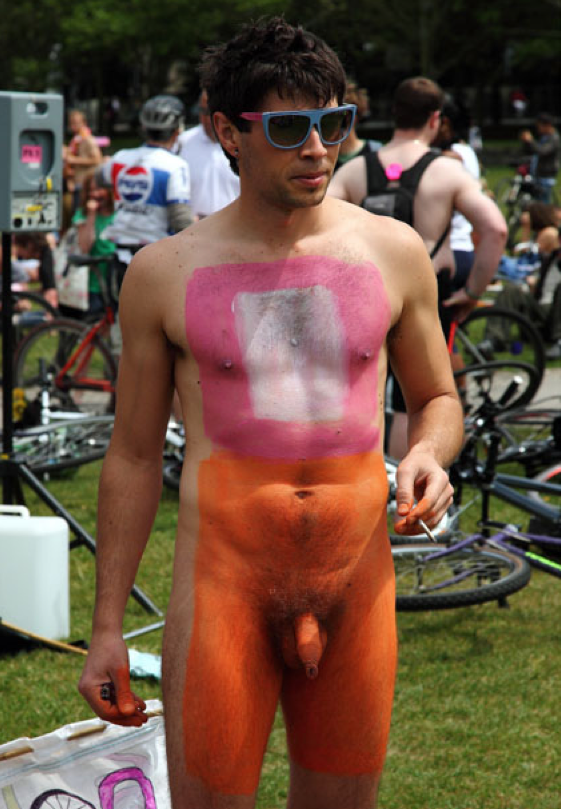
So what better excuse do we need to do a round-up of recently-emerged (and some ancient) images from assorted World Naked Bike Rides?
And although this next fella is utterly magnificent (one of my favourites, in fact, and who has stalkerishly appeared on my blogs a few times already, albeit in different poses), the general theme here is the search for the best "costume".
By which I am usually referring to a painted-on costume, of course.
A few random blue dots, like that chap has gone with, definitely counts, but, alas, I think I need to disqualify the next rider on the grounds that wearing a rucksack doesn't really require any effort and, frankly, is letting the side down a bit.
Pity.
Whereas this next chap swayed me by wittily drawing attention to his tiny willy rather than being embarrassed about it. And I like the sentiment very much, obviously:
This next chap did well to choose just a pair of sunglasses. He doesn't need anything else:
While these two boys coordinated:
I'm not so sure that was a good move, although the blond-haired chap is clearly in a different league of loveliness.
No, the chap in pole position to win the coveted "best costume" award throughout almost the whole of the judging period was the guy on the right, here, whose economical expression "I love bums" fits so well with the theme of this blog, and who has also been the subject of several crassly intrusive photo features on various of my blogs, what with him being exquisitely lovely and all:
But I have to tell you, in a major upset (particularly given our obsession with winkies, bums and goolies), the winner of this year's best costume at a WNBR event award goes to A Lady:
Genius. The hint of Marge Simpson is probably what swayed me, along with the skill of the application. Brilliant. It's almost as if winter isn't here.
Subscribe to:
Posts (Atom)